

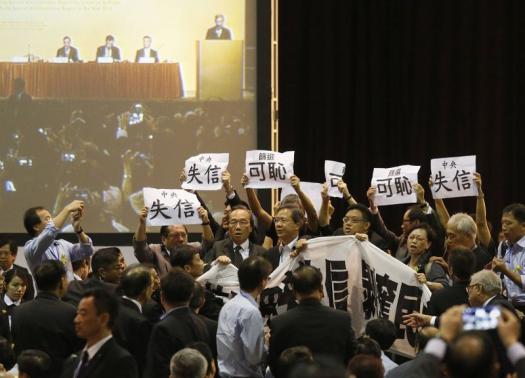

Hong Kong police on Monday used pepper spray to disperse pro-democracy activists who stormed a security check-point at a venue where a senior Chinese official was explaining Beijing’s decision not to grant the former British colony full democracy.
Scuffles had broken out at the entrance to the center where Li Fei, deputy secretary general of China’s National People’s Congress (NPC) Standing Committee, was speaking.
Pro-democracy activists inside the building heckled Li, shouting slogans and interrupting his speech explaining Beijing’s decision, announced on Sunday, to rule out a fully democratic election for the city’s next leader in 2017.
Hong Kong returned to Chinese rule in 1997 with wide-ranging autonomy and freedoms not enjoyed on the mainland – a policy called “one country, two systems”.
The activists want universal suffrage, but Communist Party rulers in Beijing say any candidate for the territory’s chief executive has to be approved by a nominating panel – likely to be stacked with pro-Beijing loyalists.
Activists from a movement called Occupy Central have threatened to blockade Hong Kong’s financial district unless Beijing grants full democracy, setting the stage for disruptive protests in coming weeks.
“Occupy Central is an illegal activity. If we give in, it will trigger more illegal activities,” Li said.
Dressed in black and wearing yellow ribbons, members of the democratic camp were escorted out of the auditorium after they shouted and held up signs reading “shameful” and saying Beijing had lost credibility.
Pro-establishment people in the crowd clapped as the democrats were led out.
Alex Chow, the head of the Hong Kong Federation of Students, was escorted out jeering and heckling. Student activists said they would begin boycotting classes in mid-September and that students at 11 schools had confirmed their participation.
About 100 activists had gathered for Li’s speech, some waving British colonial flags and banners with an “X” over the Chinese characters for “communism” amid a heavy police presence.
A group of Beijing loyalists stood nearby waving China’s flag.
The NPC Standing Committee on Sunday endorsed a framework to let only two or three candidates run in Hong Kong’s 2017 leadership vote. All candidates must first obtain majority backing from the nominating committee.
TAIWAN EXPRESSES REGRET
Li said that if Hong Kong lawmakers failed to approve Beijing’s decision, as is needed by law, the city’s next leader will be chosen by a small election committee.
China’s decision makes it almost impossible for opposition democrats to get on the ballot and prompted the Occupy Central camp to renew its vow to bring the financial hub to a halt.
Political reform has been a major source of tension in Hong Kong, with China party leaders fearful of calls for democracy spreading to other cities.
The Mainland Affairs Council in self-ruled Taiwan, which China regards as a breakaway province, expressed “regret” at the NPC’s decision while activist groups posted messages of support for the democracy movement online.
“This decision by the NPC to limit the type and number of candidates for Hong Kong’s election is a major setback for the progress of Hong Kong’s democracy, and we expressregret at this decision,” the opposition Democratic Progressive Party said in a statement.
“This decision represents a smothering of the Hong Kong people’s demand for truly representative government and casts a shadow over the progress of Hong Kong’s democratization.”
Following the publication by Beijing of a white paper outlining China’s authority over Hong Kong in June, democracy activists held an unofficial referendum on voting in the “special administrative region”, and hundreds of thousands marched to the city’s business district and staged a sit-in.
Li’s briefing was organized by the Hong Kong government and China’s Liaison Office in Hong Kong. The vice chairman of the Standing Committee’s Legislative Affairs Commission, Zhang Rongshun, and the Deputy Director of the State Council’s Hong Kong and Macau Affairs Office, Feng Wei, were also due to speak in a series of briefings throughout the day.
Student activists said they would gather outside the Hong Kong chief executive’s office in the afternoon.
Charles Rivkin, U.S. Assistant Secretary of State for Economic and Business Affairs, said in Singapore the United States backed “free and fair elections and transparency”.
“We believe, in the case of Hong Kong, in one country and two systems,” he said.
Britain made no mention of democracy for Hong Kong until the dying days of about 150 years of colonial rule.
–
Source: Reuters