

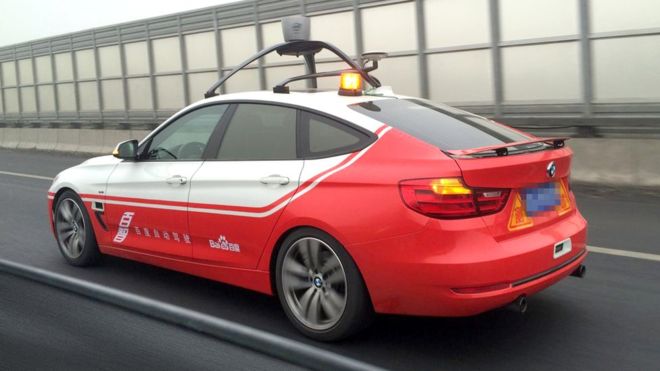

Chinese tech giant Baidu has successfully tested its driverless car on roads near the company’s headquarters in Beijing.
The 30km (18.6 miles) test route required a modified BMW 3 Series to navigate “complex road conditions”, including human drivers, the firm said.
The car executed a range of manoeuvres, including U-turns, lane changes and merging into traffic from ramps.
Baidu has amassed a library of 3D road maps to guide its autonomous vehicles.
“Fully autonomous driving under mixed road conditions is universally challenging, with complexity further heightened by Beijing’s road conditions and unpredictable driver behaviour,” said Wang Jing, senior vice-president of Baidu and general manager of the company’s Autonomous Driving Business Unit.
Baidu’s highly automated driving (HAD) maps capture road data in 3D to within a few centimetres of accuracy, according to the company.
The car is able to detect vehicles, road lanes and objects in its path.
Samsung shake-up
Separately, South Korean firm Samsung announced that it would be launching a new division which will make car components for automotive vehicles.
The Wall Street Journal reports that the company will begin by developing in-car entertainment, or infotainment, systems.
“It sounds a sensible move for them – whether it’s driver assistance or towards automation, there’s going to be a lot of development of the sensors, communications and the cloud computing,” Alan Stevens, at the UK’s Transport Research Laboratory, told the BBC.
As for Baidu’s prototype, Mr Stevens pointed out that the particular roads chosen for the test route would be indicative of the car’s true capabilities.
“I wonder whether we’re talking about very well made-up highways with good markings, the question is how does it work in more rural areas,” he said.
Self-driving derby
Competition is certainly heating up in the driverless vehicle space. Recently, German manufacturer Daimler tested a self-driving truck in motorway traffic.
And a Japanese firm, Robot Taxi, has developed a plan to provide self-driving cars to people in Kanagawa, south of Tokyo, in 2016.
It’s not all plain sailing, however.
Google’s prototype has been involved in nine crashes since testing on public roads began, though the company has said these are all the fault of humans, not the car’s autonomous technology.
In one incident, for example, people in a Google-piloted Lexus suffered whiplash after a human-driven car crashed into the back of it while it was waiting in traffic.
Finally, Elon Musk’s high tech firm Tesla has had to limit the automatic steering and lane changing functions in its autopilot mode for drivers in Hong Kong.
A report in the International Business Times said that Hong Kong’s Transport Department was still reviewing the software to ensure that it complied with the country’s regulations.
–
Source: BBC