



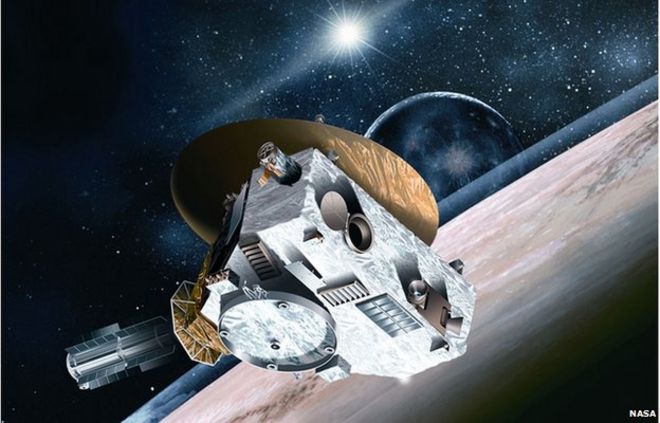
Nasa’s New Horizons spacecraft has made the first visit to Pluto, speeding past at 14km per second.
Earlier, the space agency released the most detailed picture yet as it hurtled towards the dwarf planet on Tuesday.
The probe was set to grab more images and other data as it passed just 12,500km from the little world at 11:50 GMT (12:50 BST).
The spacecraft is currently out of contact with Earth as it continues its observations.
But scientists already have colour data from the approach and said they might release another new picture of Pluto later on Tuesday.
Images set to be released on Wednesday will be more than 10 times the resolution of those already published.
New Horizons’ flyby of 2,370km-wide Pluto is a key moment in the history of space exploration.
It marks the fact that all nine objects considered by many to be the Solar System’s planets – from Mercury through to Pluto – have now been visited at least once by a probe.
“We have completed the initial reconnaissance of the Solar System, an endeavour started under President Kennedy more than 50 years ago and continuing to today under President Obama,” said the mission’s chief scientist, Alan Stern.
“It’s really historic what the US has done, and the New Horizons team is really proud to have been able to run that anchor leg and make this accomplishment.”
Talking about the latest image of Pluto that was returned just before the flyby, Nasa’s science chief, John Grunsfeld, said: “This is true exploration… that view is just the first of many rewards the team will get. Pluto is an extraordinarily complex and interesting world.”
The information that has been acquired in recent weeks on approach to the dwarf world will be as nothing to the huge number of observations captured during the flyby. But scientists have already been attempting to interpret the data and images so far.

Dr Stern said: “On the surface we see a history of impacts, we see a history of surface activity in terms of some features we might be able to interpret as tectonic – indicating internal activity on the planet at some point in its past, and maybe even in its present.
“This is clearly a world where geology and atmosphere – climatology – play a role. Pluto has strong atmospheric cycles. It snows on the surface. These snows sublimate – (and) go back into the atmosphere – every 248-year orbit.”
The probe is investigating not only Pluto but also its five moons: Charon, Styx, Nix, Kerberos and Hydra.
To achieve that, it has had to perform a furious set of manoeuvres during the flyby, pointing every which way in the sky to lock on to the different targets.
New Horizons’ call home after the flyby is due at 00:53 GMT Wednesday (01:53 BST). It will come through a giant dish in Madrid, Spain – part of Nasa’s Deep Space Network of communications antennas.
This signal will contain only engineering information on the status of the probe, but controllers should be able to tell very quickly whether the flyby sequence worked properly or not.
There is a very small possibility that New Horizons could be lost as it flies through the Pluto system.
Any stray icy debris would have been lethal if it had collided with the spacecraft at its 14km/s velocity (31,000mph).
“Hopefully it did [survive],” said Alan Stern, “but there is a little bit of drama.”
The first high-resolution pictures from the pass should be downlinked later on Wednesday.

–
Source: BBC