

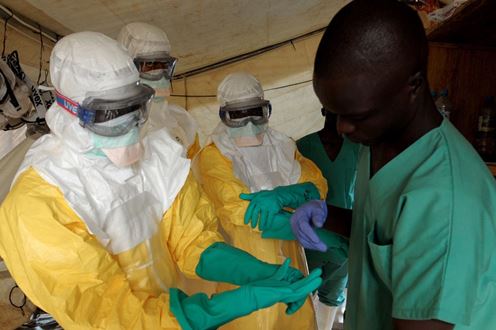

Ebola patients are missing out on basic care that could improve their chances of survival, according to a report in the Lancet medical journal.
Researchers say organisations are being misled by an “inaccurate view” that there is no proven treatment for Ebola.
They add that patients, who could be treated with fluids and electrolytes, are dying of dehydration.
Charities say there are many challenges to giving the intensive fluid replacement that some patients need.
Drugs and vaccines
Ebola has killed more than 6,000 people in the worst-affected areas of Sierra Leone, Guinea and Liberia.
The virus causes severe vomiting, diarrhoea and bleeding – all of which can lead to the profound loss of fluids and electrolytes, such as sodium and potassium.
When patients are too sick to drink they can be given fluids intravenously – using a drip through a vein.
But Prof Ian Roberts, of the London School of Hygiene and Tropical Medicine, and Prof Anders Perner, at the University of Copenhagen, say these rehydration therapies are being neglected while people focus on potential drugs and vaccines.
Prof Roberts told the BBC: “When the outbreak started, people thought there was nothing we could do unless we killed the virus.
“But it quickly became apparent when people treated in high-income countries didn’t all die that ordinary good-quality medical care makes a huge difference.
“There are some simple things – like replacing fluids and electrolytes – that could improve the fatality rate.”
‘Greater staffing’
The charity Medecins Sans Frontieres says patients are encouraged to drink but only the sickest patients are given drips, as inserting them can leave staff at risk of getting the disease.
Dr Catherine Hoolihan, of Save the Children, who is currently working at a treatment centre in Sierra Leone, told the BBC: “Some weaker patients absolutely require intravenous fluids in order to support them, but it is a challenging thing to do.
“There are concerns about the safety of having needles inside wards but we are starting to see that when there are training and facilities in place this can work.
“We also have challenges of confused patients who won’t let you put in drips. Others will pull them out. And you need people to put up the next bag of fluid.
“This requires greater staffing and patient ratios. But it would save more lives.”
Dr Charlie Weller, of the Wellcome Trust, said: “We know intensive fluid therapy can help patients but this requires more staff.
“The UK and global agencies are calling for more people to help. But giving fluids alone will not eradicate Ebola.
“Other therapies and vaccines will also be important right now and for future outbreaks.”
Source: BBC