

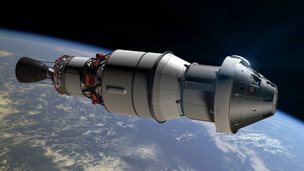

A US space capsule that could help get humans to Mars is due to make its maiden flight later.
Orion will be launched on a Delta rocket out of Cape Canaveral in Florida on a short journey above the Earth to test key technologies.
The conical vessel is reminiscent of the Apollo command ships that took men to the Moon in the 1960s and 1970s, but bigger and with cutting-edge systems.
Given that this is a first outing, there will be no people aboard.
Nonetheless, the US space agency describes the demonstration as a major event.
“This is huge; Thursday is a giant day for us,” said Nasa administrator Charlie Bolden.
Lift-off is scheduled to occur at 07:05 local time (12:05 GMT), depending on the weather and the technical readiness of all involved.

Orion is being developed alongside a powerful new rocket that will have its own debut in 2017 or 2018.
Together, they will form the core capabilities needed to send humans beyond the International Space Station to destinations such as the Red Planet.
Lockheed Martin’s Orion programme chief Mike Hawes describes the flight profile
For Thursday’s flight, the Delta IV-Heavy rocket – currently the beefiest launcher in the world – is being used as a stand-in.
It will send Orion twice around the globe, throwing the ship up to an altitude of almost 6,000km (3,600 miles).
This will set up a fast fall back to Earth, with a re-entry speed into the atmosphere close to 30,000km/h (20,000mph) – near what would be expected of a capsule coming back from the Moon.
It should give engineers the opportunity to check the performance of Orion’s critical heat shield, which is likely to experience temperatures in excess of 2,000C (4,000F).
They will also watch how the parachutes deploy as they gently lower the capsule into Pacific waters off Mexico’s Baja California Peninsula.

Although Orion is a Nasa project, the development has been contracted to Lockheed Martin, and the aerospace giant will be running the show on Thursday.
Astronaut Rex Waldheim says it would be an incredible experience to fly on board Orion
But the US space agency will be there in the background, keen to see that the LM designs meet their specifications.
A good example is the radiation protection built into the capsule. Radiation will be one of the major hazards faced on voyages into deep space, and Orion’s systems must cope with the challenge.
“We’re going to be flying through parts of the Van Allen radiation belts, since we’re 15 times higher than the space station,” explained Mark Geyer, Nasa’s Orion programme manager.
“The ISS would not have to deal with radiation but we will, and so will every vehicle that goes to the Moon. That’s a big issue for the computers. These processors that are now so small – they’re great for speed but they’re more susceptible to radiation. That’s something we have to design for and see how it all behaves.”
The animation shows how the maiden test voyage of Orion should progress
Thursday’s mission is but one small step in a very long development programme. Unable to call upon the financial resources of the Apollo era, Nasa is instead having to take a patient path.
Even if today it had a fully functioning Orion, with its dedicated rocket, Nasa would not be able to mount a mission to another planetary body because the technology to carry out surfaces operations has not been produced yet.
Nasa’s chief scientist Ellen Stofan says the road to Mars requires many more technologies
This worries observers like space historian John Logsdon, who doubts the policy as currently envisaged in sustainable.
He told the BBC: “The first launch with a crew aboard is 2020/21, and then nothing very firmly is defined after that, although of course Nasa has plans. That’s too slow-paced to keep the launch teams sharp, to keep everyone engaged. It’s driven by the lack of money, not the technical barriers.”
One solution is to pull in international partners. Europe, for instance, is going to make the “back end” for all future Orion capsules.
This service module is principally the propulsion unit that drives Orion through space. Prof Logsdon wonders if additional partners might want to pick up some of the other technologies needed to help speed the exploration path.
