

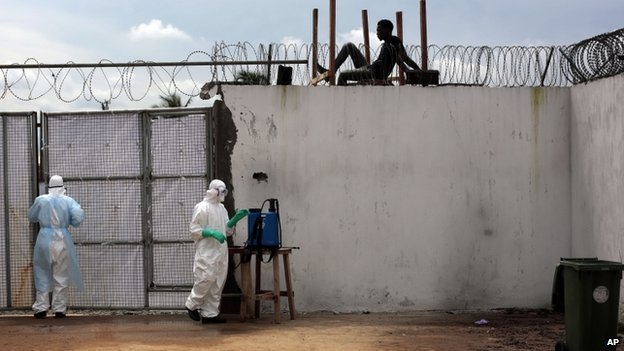

Liberia’s chief medical officer has put herself under quarantine for 21 days, after one of her assistants died from the deadly Ebola virus.
Bernice Dahn, a deputy health minister, said she had no symptoms but wanted to take every precaution.
The World Health Organisation (WHO) says more than 3,000 people have died from Ebola in West Africa.
Liberia has been the worst hit by the disease, accounting for 1,830 deaths – 150 in the last two days alone.
Health workers have been particularly vulnerable to the virus, which is spread by the infected bodily fluids of patients.
Health organisations recommend isolating people for at least 21 days, which is the maximum incubation period for the virus.
‘Every precaution’
Ms Dahn told the BBC on Saturday that she herself had decided to go into quarantine and wanted to abide by that rule.
She said she had not come into contact with any other infected people, apart from the office assistant who died this week, but wanted to take every precaution.

Ms Dahn, who represented Liberia at international Ebola conferences, has also instructed her staff to stay at home for the same time period.
The WHO highlighted the risk of infection for health workers trying to stem the outbreak in its latest report released on Friday,
It said 375 workers are known to have been infected, and that 211 have so far died from the virus in Guinea, Liberia, Nigeria and Sierra Leone.
The deaths and sickness have made it even more difficult for the already weak healthcare systems in the affected countries to cope with the outbreak.
There is a severe shortage of hospital beds, especially in Liberia.
 Ebola’s incubation period can last from two days to three weeks
The latest WHO figures indicate that more than 6,500 people are believed to have been infected in the region in the world’s most deadly Ebola outbreak.
On Friday, the International Monetary Fund (IMF) pledged to send $130m in emergency aid to the countries worst hit by the virus: Liberia, Guinea and Sierra Leone.
Some 600 people have died in Sierra Leone and a similar number in Guinea, where the outbreak was first confirmed in March.
Senegal, which has also been affected by the virus, is due to receive a flight carrying aid workers from one of the three worst affected countries, Guinea, for the first time on Saturday, AP news agency reports.
The airport in Dakar has set up a terminal specifically for humanitarian flights where thorough health checks will be conducted, the agency quotes World Food Program spokesman Alexis Masciarelli as saying.
Speaking at the United Nations General Assembly in New York this week, US President Obama called for more urgent action in the response to the outbreak.
“There is still a significant gap between where we are and where we need to be,” he said.

Ebola virus disease (EVD)

- Symptoms include high fever, bleeding and central nervous system damage
- Spread by body fluids, such as blood and saliva
- Fatality rate can reach 90% – but current outbreak has mortality rate of about 70%
- Incubation period is two to 21 days
- There is no proven vaccine or cure
- Supportive care such as rehydrating patients who have diarrhoea and vomiting can help recovery
- Fruit bats, a delicacy for some West Africans, are considered to be virus’s natural host
Source: BBC