

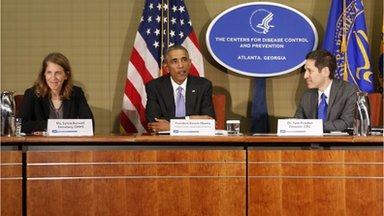

President Barack Obama has called the West Africa Ebola outbreak “a threat to global security” as he announced a larger US role in fighting the virus.
“The world is looking to the United States,” Mr Obama said, but added the outbreak required a “global response”.
The measures announced included ordering 3,000 US troops to the region and building new healthcare facilities.
Ebola has killed 2,461 people this year, about half of those infected, the World Health Organization said.
The announcement comes as UN officials have called the outbreak a health crisis “unparalleled in modern times”.
The spread of the disease means the funds needed to fight the outbreak have increased 10-fold in the past month, the UN’s Ebola co-ordinator said, saying it needs $1bn (£614m) to fight the outbreak.
‘Massive surge needed’
Among the measures announced by Mr Obama on Tuesday:
- Building 17 healthcare facilities, each with 100 beds and isolation spaces, in Liberia
- Training as many as 500 health care workers a week
- Developing an air bridge to get supplies into affected countries faster
- Provide home health care kits to hundreds of thousands of households, including 50,000 that the US Agency for International Development (USAID) will deliver to Liberia this week


Ebola only spreads in close contact but there is no cure and no vaccine. The outbreak began in Guinea before spreading to its neighbours Sierra Leone and Liberia.
Mr Obama said the outbreak had reached epidemic proportions in West Africa, as the disease “completely overwhelmed” hospitals and clinics and people were “literally dying on the streets”.
He called on other countries to step up their response, as a worsening outbreak would lead to “profound political, economic and security implications for all of us”.
There’s a “potential threat to global security if these countries break down”, he said, which would impact on everyone.
“The world knows how to fight this disease. We know if we take the proper steps we can save lives. But we have to to work fast,” Mr Obama said.
Earlier, White House Press Secretary Josh Earnest said the 3,000 troops would not provide direct care to Ebola patients. Some soldiers would be stationed at an intermediate base in Senegal, while others will provide logistical, training and engineering support at locations in Liberia.
On Tuesday, a US congressional panel heard testimony from Dr Anthony Fauci, director of the National Institute of Allergy and Infectious Disease, and Dr Kent Brantly, who recovered from an Ebola infection after receiving an experimental treatment for the disease.
Dr Fauci told the committee 10 volunteers in a separate vaccine study had shown no ill effects from an early stage trial.
Medical charity Medecins Sans Frontieres (MSF) called on other countries to follow the US lead as the response to outbreak continued to fall “dangerously behind”.
At the Ebola briefing, MSF president Joanne Liu said there needed to be a co-ordinated response under a clear chain of command.
“The window of opportunity to contain this outbreak is closing,” she said. “We need more countries to stand up, we need greater deployment, and we need it now.”

Earlier on Tuesday, the WHO welcomed China’s pledge to send a mobile laboratory team to Sierra Leone, which will include epidemiologists, clinicians and nurses.
“The most urgent immediate need in the Ebola response is for more medical staff,” WHO head Margaret Chan said in the statement.
Source: BBC