

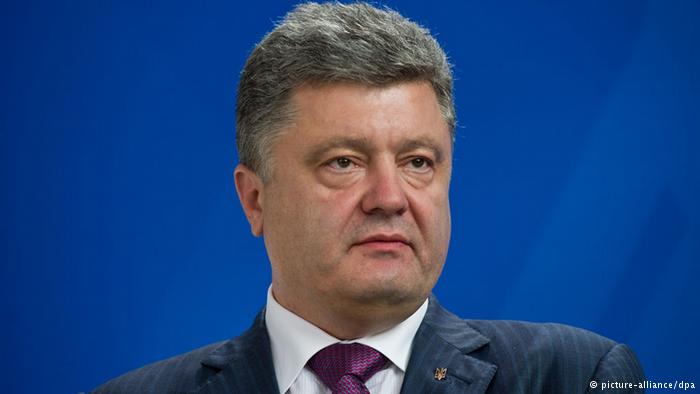

Pro-Russian rebels in Ukraine have released 1,200 prisoners, President Petro Poroshenko has said.
The releases followed Friday’s ceasefire deal, he said, which included an exchange of prisoners.
He was speaking during a visit to the strategic south-eastern port city of Mariupol, which has come under shelling from pro-Russian rebels in recent days.
Mr Poroshenko announced his arrival in a tweet: “Mariupol is Ukraine. We will not surrender this land to anyone.”
Before the truce came into place, pro-Russian separatists made big gains in eastern Ukraine and seized territory a few miles outside Mariupol.
However, despite some sporadic shooting, the ceasefire appears to be holding.
Fighting in the east has killed some 2,600 people since April.
Russia has repeatedly denied accusations by Ukraine and the West that it has been sending troops into Donetsk and Luhansk regions to help the rebels, who want to establish an independent state.
 Rebel leader held a ceremony in Donetsk on Monday to honour its defence from the Nazis in World War Two
 The conflict has sparked a humanitarian crisis in parts of eastern Ukraine – here a man distributes food at a Red Cross centre in Mariupol
 “Self-defence” battalions have set up checkpoints near Mariupol
Appeal for monitors
Mr Poroshenko said that “over the past four days, we have managed to secure the release of 1,200 of our captives”, according to the Interfax-Ukraine news agency,
The announcement came after a ceasefire was reached in Minsk, Belarus, in talks brokered by the Organization for Security and Cooperation in Europe (OSCE).
The negotiations involved former Ukrainian President Leonid Kuchma, leaders of the pro-Russian rebels, and a Russian delegate.
Mr Poroshenko appealed on Monday for the OSCE to send representatives to areas where the ceasefire has been broken.
Also on Monday, EU officials called a fresh meeting on imposing new sanctions against Moscow for 18:00 (16:00 GMT).
The meeting has been called at short notice after discussions failed to produce full agreement for the measures among all 28 member states, AFP reports.
Earlier an EU spokeswoman had said new sanctions against Russia would be adopted shortly and take effect on Tuesday.
EC’s Pia Ahrenkilde-Hansen: “The sanctions package can be extended or stopped, depending on developments in the field”
But an EU spokeswoman said the sanctions would be “reversible”, depending on the situation in Ukraine.
Major state-owned oil firms including Rosneft are on the new EU sanctions list, but gas is not affected, diplomats say. US sanctions already target Rosneft.
Russia has warned that it could block international flights through its airspace if the EU goes ahead with new measures.

Analysis: Andrew Walker, BBC economics correspondent
Rosneft calls itself the leader of the Russian petroleum industry. That makes it a very important player in the European Union’s energy market. About 90% of the crude oil used in the EU is imported and Russia is, by a large margin, the biggest supplier.
The sanctions don’t appear to directly affect that relationship. They would prevent Rosneft raising money in European financial markets.
But as crude oil is mainly transported by sea, if the trade were disrupted any losses from Russian suppliers could potentially be replaced. It would almost certainly be more expensive, but it could be done, up to a point.
Gas is another story, which may explain why Gazprom’s main business is reported not to be on the new sanctions list. Russian gas is delivered to Europe by pipeline. There is a trade in gas transported by sea, but it would be very difficult to compensate for a major disruption of supplies from Russia.
 Russian gas exports will not be affected if new sanctions are put in place, diplomats say
Diplomats say the new package will target Russian oil companies Rosneft and Transneft and the petroleum unit of state gas monopoly Gazprom.
Their access to financial markets will be restricted – a serious matter for Rosneft, which last month asked the Russian government for a $42bn (£25.2bn) loan.
The sanctions would also expand the visa bans and asset freezes on Russian officials and entities, including separatist leaders in Ukraine.
Earlier Russian Prime Minister Dmitry Medvedev warned that Moscow would respond “asymmetrically” to further sanctions.
A Russian airspace ban “could drive many struggling airlines into bankruptcy”, he told a Russian daily.
–
Source: BBC