

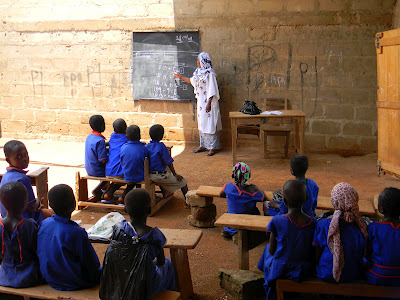

Ghana’s education system has been described as below international standards at all levels, a report by the World Economic Forum (WEF) has revealed.
The WEF in its Global Competitiveness Report 2014-2015 assesses the competitiveness of 144 countries, said the country is not sufficiently harnessing new technologies for productivity enhancements (ICT adoption rates continue to be very low).
On the overall competitiveness on higher education in the world, Ghana ranked 106 out of the 144.
The African country that ranked highest in the world was Mauritius which placed 54th. Tunisia was second placing 73rd followed by Zambia (80th) and Seychelles (85th).
The rest are South Africa (86th), Cape Verde (89th), Kenya (95th), Algeria (98th), Botswana (101), Libya (102) and Morocco (104).
Higher education and training Rank Score
Secondary education enrollment, gross %* ………. 61.1 ……….112
Tertiary education enrollment, gross %*……………. 12.2 ……….106
Quality of the education system ……………………….. 3.8 …………59
Quality of math and science education ……………… 4.4 …………52
Quality of management schools ……………………….. 4.6 …………50
Internet access in schools ……………………………….. 3.2 ……….113
Availability of research and training services ……….. 3.8 …………92
Extent of staff training …………………………………….. 4.1 …………61
In a recent debate about the quality of Ghana’s education system, the Minister of Education, Jane Naana Opoku Agyemang said she is convinced Ghana has one of the best educational systems despite major challenges facing the sector.
“We have a fine education system in this country, we have produced the best minds in any discipline that this country will be proud of,” the Minister said.
The minister compared the current system with old one saying “those were the days when no matter where you went to school, you had a fair chance of advancing yourself and of ending up in the best schools possible,” she said.
[contextly_sidebar id=”DZgBs6tvtYms3J1anKGmkdrskkZzDCF0″]She further criticized the drop in the quality of teaching and learning in basic schools and urged teachers at the various public schools to work harder to ensure that students excel academically.
Another report on the Early Grade Reading assessment released by the Ghana Education Service (GES) revealed that 98% of primary two pupils can neither read nor understand English.
The GES has admitted that the survey “results are not acceptable” but despite the appalling statistics, the general public should not “rush to start making any serious conclusions about it,” because they are working to turn things around.
The Global Competitiveness Report’s competitiveness ranking is based on the Global Competitiveness Index (GCI), which was introduced by the World Economic Forum in 2004.
The report said labor markets are characterized by inefficiencies, and the country is not sufficiently harnessing new technologies for productivity enhancements (ICT adoption rates continue to be very low).
Defining competitiveness as the set of institutions, policies and factors that determine the level of productivity of a country , GCI scores are calculated by drawing together country-level data covering 12 categories – the pillars of competitiveness – that collectively make up a comprehensive picture of a country’s competitiveness.
The 12 pillars are: institutions, infrastructure, macroeconomic environment, health and primary education, higher education and training, goods market efficiency, labour market efficiency, financial market development, technological readiness, market size, business sophistication, and innovation.
By: Nana Boakye-Yiadom/citifmonline.com