

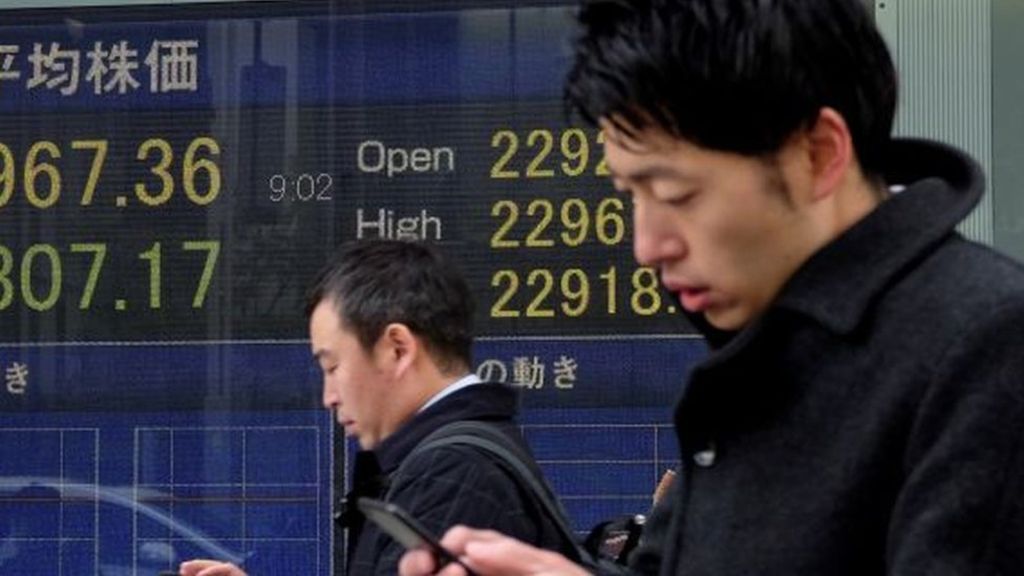

Asian markets plunged on Tuesday as investors dumped stocks following heavy falls in the US in anticipation of higher interest rates.
Japan’s Nikkei 225 index suffered its biggest one-day point drop since 1990, before recovering.
It comes after the Dow Jones Industrial Average suffered its worst drop in more than six years on Monday.
A strengthening global economy and healthy corporate earnings had spurred world markets to record highs.
But the sell-off began last week after a solid US jobs report fuelled expectations that the Federal Reserve will raise interest rates faster than expected.
“Economic news from the US has been stronger than anticipated,” said David Kuo, chief executive of financial services advisory Motley Fool.
“So, perversely, the market correction has been caused by positive economic news.”
Markets in Asia typically follow the lead from the US.
Elsewhere in the region, Japan’s Nikkei 225 index closed down 4.7%, while Hong Kong’s Hang Seng dropped 4.5% and South Korea’s Kospi index gave up 2.6%. Australia’s benchmark S&P/ASX 200 lost 3.2%.
US stock futures were pointing to more sharp falls when markets open on Tuesday.
What happened in the US?
On Monday the Dow Jones Industrial Average index tumbled 1,175 points, or 4.6% to close down at 24,345.75.
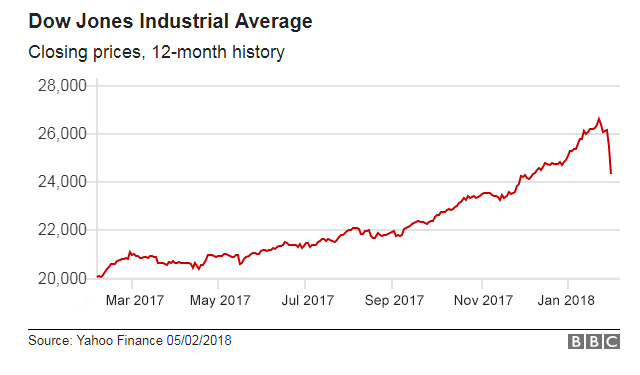
The decline was the largest in percentage terms for the Dow since August 2011, when markets dropped in the aftermath of “Black Monday” – the day Standard & Poor’s downgraded its credit rating of the US.
The drop on the Dow was closely followed by the wider S&P 500 stock index, down 4.1% and the technology-heavy Nasdaq, which lost 3.7%.
The White House moved to reassure investors saying it was focused on “long-term economic fundamentals, which remain exceptionally strong”.
Why is this happening?
The heavy losses in Asia track the slide on Wall Street. Investors are reacting to changes in the outlook for the American and global economy, and what that might mean for the cost of borrowing.
“The share selling….reflects a higher than previously anticipated interest rate environment,” CMC Markets analyst Michael McCarthy said.
In response to that, investors moved to sell out of stocks and put money into assets like bonds which benefit from higher interest rates.
“This isn’t a collapse of the economy. This isn’t a concern that markets aren’t going to do well,” said Erin Gibbs, portfolio manager for S&P Global Market Intelligence.
“This is concern that the economy is actually doing much better than expected and so we need to re-evaluate,” she said.
Will this have long-term impact?
Analysts say that in the short term, investors should be prepared for choppier stock markets.
Joel Prakken, chief US economist for IHS Markit, predicts share price gains will be limited over the next two years.
“The difference between this year and last year is we’re going to see more periods of volatility like this as the market reacts to higher inflation,” he said.
“We’re just not used to it because it’s been so long since we’ve had a significant correction.”
However, he added that markets would need to deteriorate more significantly for him to start to worry about the broader economy.
Asian markets, on the other hand, have benefitted from record low US interest rates in the last decade because money has flowed into Asia in search of stronger returns. Analysts say the expected rate rises could impact Asia over the longer term.
–
Source: BBC