


The World Health Organization has determined it is ethical to provide experimental treatments to patients infected with the Ebola virus.
The panel of medical experts met in Geneva to discuss the merits of using untested drugs.
Some 1,013 people have died from the virus in West Africa.
The move came as Liberia announced it was set to receive an experimental drug, Zmapp, after requests made to the US government.
The WHO said it had been persuaded to recommend the move because of the scale of the outbreak and large number of deaths.
Where experimental treatments are used there must be informed consent and the results of the treatment collected and shared, the WHO said.

In a statement, it added: “In the particular circumstances of this outbreak, and provided certain conditions are met, the panel reached consensus that it is ethical to offer unproven interventions with as yet unknown efficacy and adverse effects, as potential treatment or prevention.”
Last week the WHO declared the Ebola outbreak was a global health emergency.
What drugs exist currently ?
There a handful of drugs that have been shown to work well in animals.
One is Zmapp – the drug requested by the Liberian government. This contains a cocktail of antibodies which attack proteins on the surface of the virus.
Only one experimental drug has moved into early human testing. Known as TKM-Ebola this interrupts the genetic code of the virus and prevents it from making disease causing proteins.
The drug was tested on healthy human volunteers at the beginning of 2014 but the American medicines regulator asked for further safety information. The drug company says human trials may soon resume.
Vaccines to protect against acquiring the disease have also been shown to work in primates. American authorities are considering fast-tracking their development and say they could be in use in 2016.
But experts say ultimately the only way to be sure a drug or vaccine is effective is to see if it works in countries affected by Ebola.
Meanwhile, the Liberian Government said experimental drugs will be brought into the country later this week – although manufacturer Mapp Biopharmaceutical warned supplies are limited.
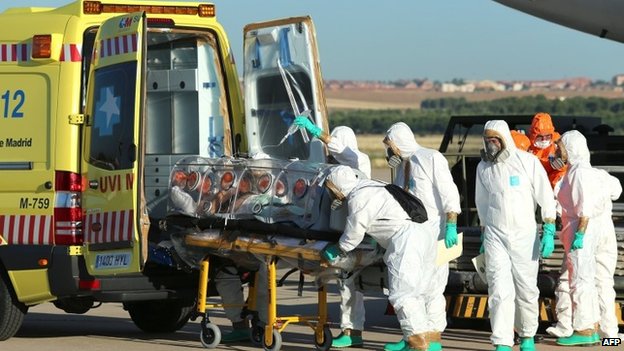
Zmapp has been used on two US aid workers who have shown signs of improvement. A Roman Catholic priest, infected with Ebola in Liberia, who died after returning home to Spain is also thought to have been given the drug.
However, the drug has only been tested on monkeys and has not yet been evaluated for safety in humans.
‘Hard place’
There is no cure for Ebola, which has infected at least 1,779 people since the outbreak was first reported in Guinea in February.
The Liberian government said it was aware of the risks associated with Zmapp, but the alternative was to allow many more people to die.
“The alternative for not testing this is death, a certain death,” Information Minister Lewis Brown told the BBC.
“This is not even the rock and the hard place for us.
“We think those who have been infected should be given the chance to have that tested on them if they give their consent to do so.
“We know there may be risks associated with it,” the minister added, “but choosing a risk and choosing dying I am sure many would prefer to see that risk happen”.
Ebola’s initial flu-like symptoms can lead to external haemorrhaging from areas like eyes and gums, and internal bleeding which can lead to organ failure. Patients have a better chance of survival if they receive early treatment
–
Source: BBC