

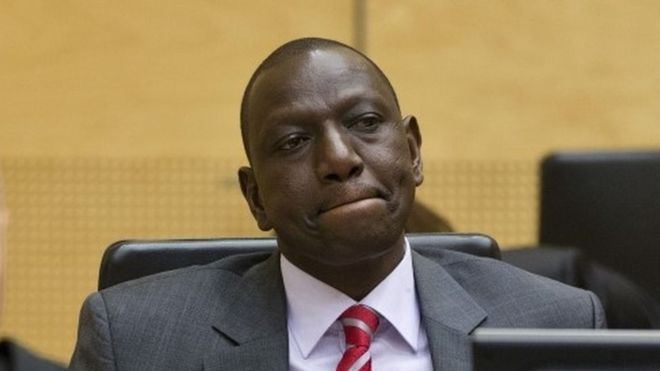

Kenyan Deputy President William Ruto is due to find out whether a crimes against humanity case against him will be thrown out by judges at the International Criminal Court (ICC).
Mr Ruto denies murder, deportation and persecution charges during violence that followed the 2007 elections in which about 1,200 people were killed.
His lawyers want the case to be terminated due to a lack of evidence.
Mr Ruto is one of the most senior politicians to be tried by the ICC.
The prosecution case against him has been dogged by repeated setbacks.
In February judges at the ICC barred the use of recanted testimony, meaning that prior recorded witness statements could not be used by prosecutors.
Several key witnesses in the case have changed their statements, which prosecutors said was due to intimidation and bribery.
Mr Ruto’s lawyers say he should be acquitted because so many key prosecution witnesses have either dropped or changed their original statements.
ICC prosecutor Fatou Bensouda has acknowledged that the loss of witnesses has weakened the case against the deputy president – but she has argued there still remains enough evidence to proceed with the trial.
A spokesman for the ICC has told the BBC’s Anna Holligan in The Hague there are a number of possible scenarios.
The judges could clear Mr Ruto of all the charges, they may ask the prosecution to consider changing the charges or they could reject the defence team’s arguments and allow the trial to continue.
In 2014, the prosecutor dropped similar charges against Kenyan President Uhuru Kenyatta, alleging that witnesses had been intimidated to make them change their testimony.
The future of the case now appears to depend on whether the prosecution has proved that it has sufficient evidence to offset a no-case-to-answer move from Mr Ruto’s lawyers.
The use of prior testimony falls under Rule 68 of the Rome Statute, which set up the ICC.
But William Ruto’s defence team argued this was unfair because changes to the rule were brought in after the case against him and his fellow defendant, the journalist Joshua arap Sang, had started.
Presiding Judge Piotr Hofmanski ruled that prior-recorded testimony was delivered without an opportunity for the accused to cross-examine the witnesses.
Mr Sang, who is accused of using his radio show to organise attacks in the election aftermath, said at the time that the decision was “one step to our freedom”.
Mr Ruto and Mr Kenyatta were on opposite sides of the 2007 election, but formed an alliance that won the 2013 election.
–
By: BBC