

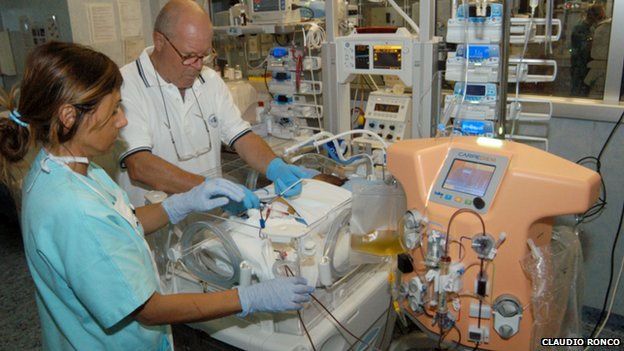

Italian scientists have designed a dialysis machine specifically to treat babies with kidney failure, which they say could improve treatment.
Dialysis machines for adults can cause complications when used in very young children, the Lancet study says.
The miniaturised machine has been tested on a newborn with multiple organ failure, whose kidney function was restored after 30 days.
UK experts warn dialysis is still very challenging, even with new equipment.
Prof Claudio Ronco, from the International Renal Research Institute at San Bortolo Hospital in Vicenza, designed and developed the new machine to treat babies and small infants weighing between 2kg and 10kg (4lb and 1st 8lb).
In his study, published in the Lancet, he said adult kidney dialysis machines were inaccurate and potentially unsafe when used in those babies.
Smaller scale
Prof Ronco said: “A major problem is the potential for errors in ultra-filtration volumes.
“Adult dialysis equipment has a tendency to either withdraw too much fluid from a child, leading to dehydration and loss of blood pressure, or too little fluid, leading to high blood pressure and oedema.”
The new machine – named Carpe Diem (cardio-renal pediatric dialysis emergency machine) – replaces the lost function of the kidney by removing excess fluid and urine from the body through blood vessels.
It allows the use of a much smaller-sized catheter than normal which could prevent damage to blood vessels in babies, the study says.
In August 2013, a baby born prematurely weighing 2.9kg was the first person to be treated using the device. She had multiple organ failure after a complicated delivery.
After more than 20 days of treatment with the new machine, doctors were able to discontinue kidney dialysis on the patient.
Organ function was restored and the infant was discharged from hospital after 50 days, although she still had significant kidney dysfunction, the study notes.
Prof Ronco said: “We hope that our success will encourage the development of other medical technologies (eg catheters, fluids, and monitors) specifically designed for infants and small children.”
‘Challenging procedure’
Dr Jan Dudley, consultant paediatric nephrologist at Bristol Royal Infirmary, said she welcomed any equipment more suited to treating newborns, but she said it was “not impossible” to dialyse small babies with the current machines,’
“We do already treat about a dozen newborns successfully every year in the UK,” she said.
“Even though treatments have improved dramatically in the past two decades, it’s still a very challenging procedure – there is only a 75% survival rate for these babies in their first 10 years of life.”
Dr Meeta Mallik, a children’s kidney specialist at Nottingham Children’s Hospital, said there was a role for the Italian machine and it would give clinicians “more options for treating this challenging group of patients”.
Writing in another article in The Lancet, Benjamin Laskin, from the Children’s Hospital of Philadelphia, and Bethany Foster, from Montreal Children’s Hospital in Canada, said the machine needed to be tested out on more young patients.
Elaine Davies, head of research at Kidney Research UK, said: “Although there are ways to dialyse very small babies with kidney failure, this is an interesting development and a step in the right direction in paediatric renal care.
“It will be interesting to see if, in the long term, this results in improved outcomes for babies with renal failure.”
Source: BBC