

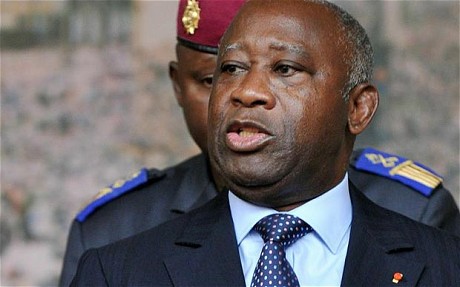

Ivory Coast’s ex-President Laurent Gbagbo has denied charges of war crimes and crimes against humanity, as his landmark trial began at the International Criminal Court (ICC).
The charges relate to the country’s civil conflict that erupted after Mr Gbagbo lost elections in 2010.
He is the first ex-head of state to stand trial at the ICC in The Hague.
Mr Gbagbo and ex-militia leader Charles Ble Goude, 44, both deny murder, rape, attempted murder and persecution.
The trial could last three or four years.
As it began, Mr Gbagbo, 70, appeared relaxed, smiling and shaking hands with his defence team.
The BBC’s Anna Holligan, at the trial, said he steadied himself on his desk as he replied “not guilty” as the charges were read.
A key test, by Anna Holligan, BBC News, The Hague
This may prove to be the most important trial in the ICC’s history. The international court was established to end impunity and bring the most powerful leaders to justice. The first trial of a former head of state is testament to the prosecutor’s reach. And yet, despite casualties on both sides, not one of President Alassane Ouattara’s supporters has been charged, leading to accusations of victor’s justice.
During the pre-trial press briefing the victims’ representative was asked how she could represent the victims when only half of those who had suffered would have their voices heard.
This high-profile trial will test the ability of the ICC to obtain reliable evidence from a country in which the government has a political interest in securing a guilty verdict.
Can the suspects expect a fair trial if much of the evidence comes from their enemy?
Mr Gbagbo sparked a crisis in Ivory Coast after he refused to step down following his loss to Alassane Ouattara in the 2010 presidential vote.
There were bloody clashes between rival forces over five months in 2010 and 2011.
Some 3,000 people were killed, with Mr Gbagbo basing himself in the presidential palace.


He was arrested in April 2011 by forces loyal to President Ouattara, backed by troops from former colonial power France, and later that year was extradited to The Hague.
It will be the highest-profile trial yet for the ICC, which has only convicted two Congolese warlords since its establishment in 2002.
Reading out the charges, prosecutors cited cases including the alleged rape of 38 women at a pro-Ouattara rally and alleged killing of 10 people by shelling at a market.
The prosecution said it currently planned to bring forward 138 witnesses.
Chief prosecutor Fatou Bensouda said that when Mr Gbagbo “understood that the presidency was going to escape him… he began a campaign of violence orchestrated against those considered opponents”.
“Nothing would be allowed to defeat Mr Gbagbo, and if politics failed, violence was seen as politics by other means,” she said.
Presiding Judge Cuno Tarfusser said neither Ivory Coast nor its people were on trial, and that he would not allow the court to be used as a “political instrument”.
Dozens of Gbagbo supporters gathered outside the ICC on Thursday to back the ex-president, sparking some scuffles with police.
“Our dream to see our president walk free starts today,” said one supporter, Marius Boue. “He is truly a man of the Ivorian people.”
Other supporters gathered in the Gbagbo stronghold of Youpugon in Ivory Coast’s commercial capital, Abidjan, to follow the trial.
Gbagbo: From professor to president

Born in 1945, Mr Gbagbo’s first career was in academia as a history professor
He was jailed for two years in 1971 for “subversive” teaching
By the 1980s, he was heavily involved in trade union activities
After years in exile, he returned to Ivory Coast to attend the founding congress of the Ivorian Popular Front in 1988
Mr Gbagbo was one of the first to challenge Ivory Coast’s founding President Felix Houphouet-Boigny, after multi-party politics were permitted
Became president with the Ivorian Popular Front in 2000
Profile: Laurent Gbagbo
Mr Gbagbo’s followers accuse the ICC of overlooking alleged crimes by his opponents, many of whom are now in power.
But this was rejected by Ms Bensouda, who said investigations into the pro-Ouattara camp had been “intensified”.
Mr Gbagbo is the first ex-head of state to appear at the ICC, although Liberia’s former President Charles Taylor also stood trial at The Hague.
Mr Taylor appeared before the Special Court for Sierra Leone and was given a 50-year jail sentence in 2012 on charges of aiding and abetting war crimes during the civil war in Sierra Leone, which neighbours Liberia.
The ICC has been accused by some in Africa of unfairly targeting the continent.
An attempt to prosecute Kenyan President Uhuru Kenyatta over post-election violence failed amid allegations witnesses had been intimidated.
Why did Ivory Coast descend into civil war?

The country had been divided since 2002, with rebels in control of the mainly Muslim north. They mostly supported Alassane Ouattara, a Muslim whose family originate in neighbouring Burkina Faso. So when Laurent Gbagbo refused to accept defeat to Mr Ouattara in the 2010 election, fighting soon broke out.
Was the conflict about religion?
Not really – more about identity. Mr Gbagbo and other southern, Christian politicians portrayed themselves as “true Ivorians”, in contrast to northern Muslims, many of whom had foreign origins. Under Mr Gbagbo, many northerners were not allowed to vote, while Mr Ouattara was banned from standing for election until 2010. In western Ivory Coast, the conflict also took on ethnic lines.
What happened during the conflict?
In the worst cases, Ivorian security forces loyal to Mr Gbagbo shelled areas of the main city Abidjan, where many northerners lived.
The ICC also accuses pro-Gbagbo militias of attacking members of ethnic groups believed to support Mr Ouattara. But pro-Ouattara forces were also accused of similar atrocities and these have not been prosecuted.
–
By: BBC