

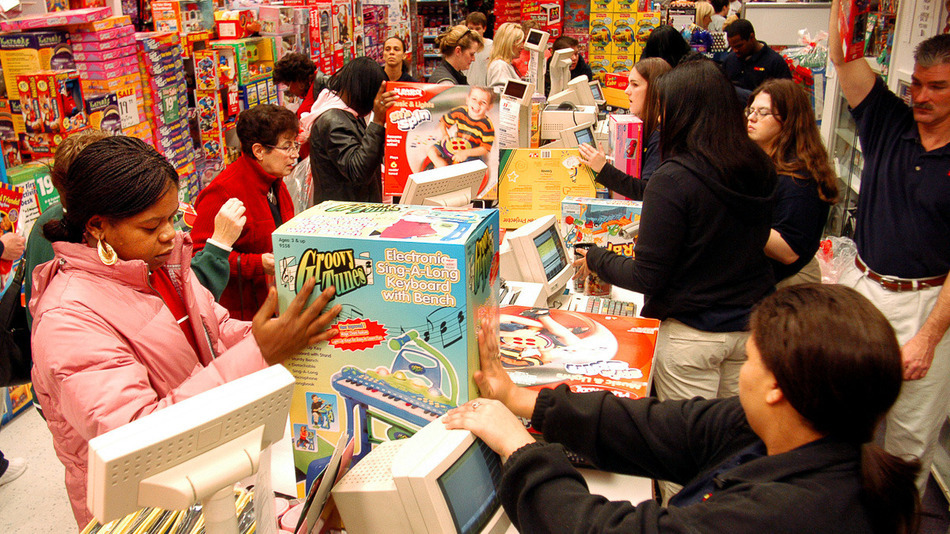

Are you panicking about last-minute gift shopping?
Here’s another reason to worry: where you choose to shop might affect your credit score.
Most of us are probably aware of many ways in which the holidays might not be good for our finances—including the fact that a higher credit card balance can contribute to a lower credit score.
But this shopping season may affect your creditworthiness in more ways than you think.
Over the past few years, a number of companies have started to apply big data analytics to credit scoring, broadening credit metrics beyond the traditional factors like as your payment history and the amounts you owe.
The new, alternative factors include other financial information, such as the balance in your savings and retirement accounts, and whether you pay your utility bill on time.
But the new factors in your credit score also can include far-flung data points like what you post on Facebook, how many text messages you send, and yes, where you shop both online and in real world retail stores.
The practice of including shopping habits in credit evaluations began as early as 2008, and was not limited to fringe companies you’ve never heard of.
In one case, an Atlanta businessman arrived home from vacation to find a letter from American Express informing him that his credit limit had been lowered—from $10,800 to $3,800. The reason? “[O]ther customers who have used their card at establishments where you recently shopped have a poor repayment history with American Express.”
American Express has since forsworn this particular tactic. But there is no question that the general practice of evaluating a person’s creditworthiness based on a series of seemingly obscure factors has increased. ZestFinance, for example (tag line: “underwriting, meet big data”), boasts a process that “analyzes thousands of potential credit variables—everything from financial information to technology usage” in its patented scoring model to predict a borrower’s value as a long-term credit customer.
Kreditech, another data-driven credit scoring company operating outside the U.S., uses “20,000 dynamic data points.” Among these are a prospective borrower’s e-commerce shopping behavior and information about a person’s physical location, gleaned from GPS and other sources.
This bears repeating: In figuring out your creditworthiness, some companies look not only at where you shop, but where you drive or walk or buy a cup of coffee.
Alternative credit scoring models can help extend credit to people who would be ineligible for credit under traditional circumstances—typically young people just entering the work-force and low-wage earners with little or no credit information on file. Expanding the information that is considered in a credit score may help millions of American gain access to the mainstream U.S. financial system.
There are downsides too, though. In addition to giving you a vaguely “creepy” feeling that everything you do is being recorded and analyzed, alternative credit scoring models that consider factors like your social media use and retail habits are a problem for a number of reasons.
First, including some of these data points means that your creditworthiness may be based on factors completely outside your control, like other people’s shopping habits. Credit scoring based on where you shop amounts to guilt by retail association.
Perhaps even more suspect, credit scoring based on the selection of stores available to you because of where you live, rather than your actual capacity to borrow responsibly, essentially amounts to guilt by zip code.
Second, the actual predictive value of these big data models is not established. The companies say they’ve conducted “hundreds of tests” to confirm their scoring models’ accuracy. But the secret sauce recipes of “thousands of potential credit variables” are proprietary, as are the algorithms run on those variables. Without public, independent studies, the reliability and predictive value of these new models cannot be assumed. The more “alternative” the data being scored is, the less likely it is to have been evaluated.
Changing your retail habits to avoid a lower credit score should not be the answer. But during this season of increased shopping, it certainly doesn’t hurt to check your credit score—twice.
–
Source: Mashable