

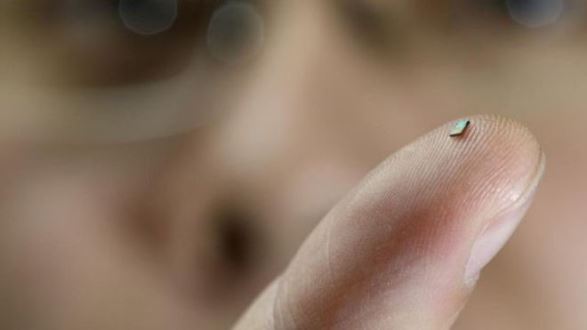

Dutch scientists have developed a tiny sensor powered by the radio waves it uses to communicate information.
Such sensors could help advance the nascent Internet of Things industry, researchers at Eindhoven University of Technology said.
Increasingly tiny chips that measure temperature, light, and air pollution are being deployed around cities and in smart homes and offices.
One the biggest hurdles is to make these sensors battery-free.
“We don’t want hundreds of these sensors around our homes if we have to go around swapping the batteries all the time,” said lead researcher Prof Peter Baltus.
The sensor developed by his team measures temperature but similar sensors that measure light, movement and humidity could also be developed, he told the BBC.
The sensor measures just 2 sq mm and weighs 1.6mg.
Low cost
The sensor contains an antenna that captures energy from a wireless router. It stores the energy and, once there is enough, is able to measure the temperature and send a signal to the router.
Currently the chip has a tiny range – just 2.5cm but the researchers are confident that this can be extended to 1m.
“Theoretically it can work up to 5m,” said Prof Baltus.
The sensor can operate beneath a layer of paint, plastic or concrete – making it ideal for incorporation into buildings.
It is also cheap and, according to Prof Baltus, the cost of an individual chip would be around 20 cents.
According to Gartner, the Internet of Things market is set to explode. It predicts that cities will have 1.6 billion connected things, smart buildings, 518 million and homes, one billion, in 2016.
–
Source: BBC