

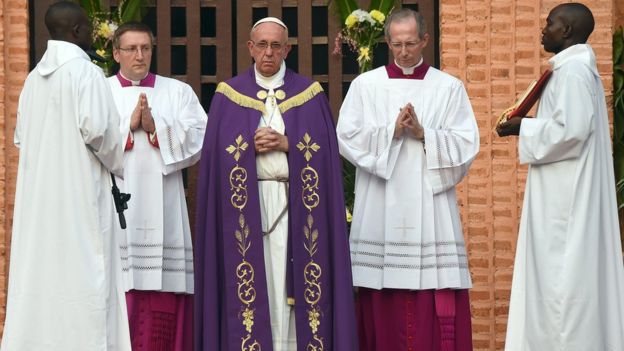

Pope Francis, speaking during Mass in the Central African Republic (CAR) capital Bangui, has called on fighting factions to lay down their weapons.
Instead, he said, they should arm themselves “with justice, love, mercy and authentic peace.”
Earlier he said he hoped next month’s polls in the CAR would open a “new chapter” for the country.
CAR has been torn apart by violence between Muslim rebels and Christian militias.
It is the pontiff’s first visit to a conflict zone and the final stop on his landmark three-nation African tour.
Acting President Catherine Samba-Panza has asked him for “forgiveness” for the country’s recent religious violence.
Large crowds lined the road from the airport to welcome the Pope – and people cheered and sang when he arrived at a refugee camp.
In an address at the presidential palace, he called for unity and to avoid “the temptation of fear of others, of the unfamiliar, of what is not part of our ethnic group, our political views or our religious confession”.
The Pope said ahead of his trip he was determined to bring a message of peace and hope to the country.
The pontiff is expected to meet Muslim leaders and visit a mosque in the city’s Muslim enclave, known as PK5, on Monday.
He will then conclude his visit with a final Mass in Bangui.
At the scene: Caroline Wyatt, BBC religious affairs correspondent
Rarely has a Pope landed somewhere with armoured vehicles on the tarmac and a refugee camp full of displaced people within sight. Many in Bangui had worried that the Pope might cancel his visit, after fears that his security could not be guaranteed.
This visit to a conflict zone is not only a first for a Pope, but also a crucial signal from the outside world to the people of this troubled nation that such a leader has come to bring a message of peace.
Pope Francis’s arrival in the Central African Republic has delighted the people who lined the streets to see him. Signs welcoming “Pape Francois” were everywhere in the capital of this French-speaking country, and the excitement was palpable.
One woman hoping for a glimpse of the Pope expressed her joy after his plane landed, saying his visit here brought real hope in dark times.
Can Pope tackle religious divide in CAR?
The Pope’s African tour also took in Uganda and Kenya.
In Uganda, the Pope celebrated Mass in front of an audience of hundreds of thousands of people, and spoke at a Catholic shrine dedicated to Christians martyred for their faith in the 19th Century.
On Friday, the Pope addressed an audience of young people in the Kenyan capital, Nairobi, urging them to unite and take a stand against the destructive effects of tribalism.
Central African Republic:
Population: 4.6 million – 50% Christian, 15% Muslim, 35% Indigenous beliefs
Years of conflict and misgovernance
Conflict only recently along religious lines
Previously ruled by Emperor Jean-Bedel Bokassa
Rich in diamonds
10,000-strong UN force took over a peacekeeping mission in September 2014
France has about 2,000 troops in its ex-colony, first deployed in December 2013
War has blighted the CAR for decades but it was only two years ago the fighting took on a religious form.
President Francois Bozize was ousted in a coup in March 2013 and a group of mostly Muslim rebels from the north, the Seleka, marched on Bangui, briefly taking control of the country.
Their rebellion tapped into a feeling northerners had of being excluded and unrepresented by the central government, correspondents say.
They targeted churches and Christian communities, which triggered the creation of the anti-Balaka – meaning anti-violence – militias, and led to a downward spiral of tit-for-tat violence which continues.
Towns and villages are divided, with hundreds of thousands of people displaced into camps divided along religious lines.
–
By: BBC