

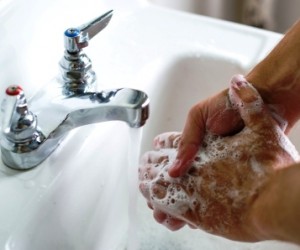

To mark Hand Hygiene Day; May 5, the World Health Organization (WHO) is urging health workers to practice good hand hygiene when caring for patients, to protect them from contracting infections in health facilities.
Initial results from a new WHO global survey confirm that these infections are often resistant to the antibiotic used to treat them.
The report explained that healthcare-associated infections usually occur when germs are transferred by healthcare providers’ hands touching the patient.
It said, of every 100 hospitalized patients, at least seven in high-income and 10 in low-/middle-income countries will acquire a healthcare-associated infection.
Among the critically ill and vulnerable patients in intensive care units, that figure rises to around 30 per 100.
The report noted that every year, hundreds of millions of patients around the world are affected by healthcare-associated infections, a high proportion of which is caused by germs that are resistant to antimicrobial drugs.
It said, when patients are infected with germs that do not respond well to antibiotics, they generally have worse clinical outcomes, cost more to treat, and are more likely to die than other patients.
The initial results of the global survey confirm that resistance is very frequent in bacteria isolated in health-care facilities; for instance, for a devastating bug called Methicillin-resistant Staphylococcus aureus (MRSA), it is as high as 44 per cent, 40 per cent and 38 per cent on average in Latin America, West African countries, and Europe respectively.
“There is clear scientific evidence that good hand hygiene by health workers reduces healthcare-associated infections caused by resistant germs, in particular by MRSA,” said Professor Benedetta Allegranzi, technical lead of the WHO Clean Care is Safer Care programme and of the activities planned for Hand Hygiene Day.
Health workers could play a vital role to protect patients from infections that are difficult to treat by performing hand hygiene at five key moments, preferably by using an alcohol-based rub, or by hand washing with soap and water if hands are visibly dirty.
According to the report, the ‘Five Moments’ for hand hygiene are before touching a patient, before clean and aseptic procedures (e.g. Inserting devices such as catheters), after contact with body fluids, after touching a patient, and after touching patient surroundings.
It said the use of alcohol-based hand rub products is a key factor to achieve improvement, because they can be promptly used at the point of care when hand hygiene is needed to ensure patient safety and they have higher antimicrobial effect than soap and water.
“Although the development of new antibiotics is vital to provide new treatment options, strengthening hand hygiene and other infection control best practices has the potential to stop antimicrobial resistance. Preventing the transmission and spread of the germs, avoids infections and the related treatment constraints and patient suffering,” said Dr. Edward Kelley, Director, Service Delivery and Safety which hosts the Clean Care is Safer Care programme.
For this year’s “SAVE LIVES: Clean Your Hands” Campaign, the Call to Action is “No action today; no cure tomorrow – make sure the WHO ‘5 Moments’ are part of protecting your patients from resistant germs.” Under this year’s Campaign, more than 1100 health facilities have registered, committing to practice good hand hygiene, joining more than 16,000 health facilities in 168 countries that have committed in previous years.
“This continuous increase of participation shows that hand hygiene efforts continue to be prioritized and sustained worldwide, especially when combined with other important goals such as combating antimicrobial resistance,” said Professor Didier Pittet, Director of the WHO Collaborating Centre on Patient Safety (Infection Control) at the University of Geneva Hospitals.
Through the SAVE LIVES: Clean Your Hands campaign, WHO would continue to work with countries to highlight the issue of antimicrobial resistance and to promote the role that hand hygiene could play in preventing the spread of resistant germs.
Source: GNA