

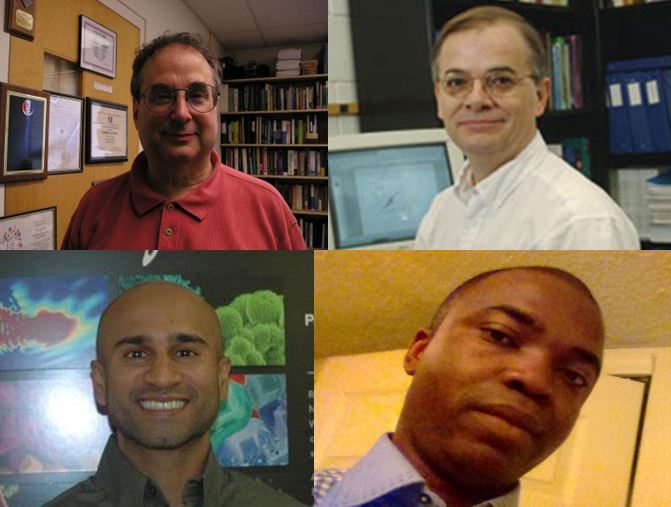

A paper published by a Ghanaian, Dr. Ayuba Fasasi in the journal of chemometrics -J. Chemom., 2014, volume 28, pages 385-394- led to his selection as the winner of the 2015 Kowalski prize for the “Best Application Paper” in 2015.
The paper is entitled “Search prefilters for mid-infrared absorbance spectra of clear coat automotive paint smears using stacked and linear classifiers”.
The selection committee selects from a pool of publications in chemometrics all over the world.
In the award letter, the managing editor of the journal of chemometrics, Professor Paul Trevorrow wrote …..”The selection committee commented that the application covered in the paper, i.e., classifying clear-coat automotive paint smears by mid-infrared spectroscopy, was a difficult, useful and interesting problem.
The paper provides an effective method for differentiating paint samples by assembly plant and subsequent classification of individual samples with a high level of accuracy. The paper provided a useful assessment of various search pre-filter methods for solving difficult classification problems.

The selection committee also noted that the paper was clearly written, and illustrates the great potential of chemometrics in interdisciplinary applications.”
The Kowalski prize is given each year, and alternates between “best theoretical paper” and “best applied paper”. For 2015, it was awarded to Barry K. Lavine, Ayuba Fasasia, Nikhil Mirjankara, Mark Sandercock and Steven D. Brown.
Ayuba Fasasi was raised in Tumu in Ghana’s Upper West Region where he had his primary and Junior Secondary School education. After pursuing his ‘O’- and ‘A’-Levels in Nandom and Navrongo Secondary Schools respectively, he proceeded to University of Cape Coast where he obtained a BS in chemistry.

Prior to his PhD program, Fasasi worked at the Environmental Chemistry Division of the Water Research Institute (WRI) of Council for Scientific and Industrial Research (CSIR), Ghana, under the National Service Scheme. He also did a summer internship program with Ghana Water Company Limited whilst pursuing his undergraduate program in UCC.
He then proceeded to pursue a PhD at the University of Idaho (UI) in USA (2005-2010) with a major in Analytical Chemistry.
His research focus emphasized applications of Vibrational Spectroscopy. He worked under the auspices of Professor Peter R. Griffiths, an internationally renowned expert with an outstanding track record in this field.
After completing his Ph.D., Dr. Fasasi accepted a post doctoral research position with Professor Barry Lavine at Oklahoma State University (OSU) where he worked on national institute of justice (NIJ) funded projects. Professor Lavine is an internationally recognized expert in chemometrics, which is the application of multivariate statistics to problems of chemical analysis.
In the past ten years, chemometrics has become the method of choice for the understanding of complex chemical systems.
As part of his work, Dr. Fasasi developed forensic applications of infrared spectroscopy with particular emphasis on extracting evidentiary lead information from clear coat paint smears that all too often are the only layer of automotive paint left at the crime scene.
By this approach, the make and model of an automobile within a limited production year range can be identified from a clear coat paint sample at a hit and run crime scene. The use of search prefilters to retrieve the identities of automobiles at crime scenes generates fewer hits, with greater accuracy, translating into a significant time savings for the forensic scientist.
Information derived from the these searches also serves to quantify the general discrimination power of original automotive paint comparisons encountered in casework, and will further efforts to succinctly communicate the significance of the evidence to the courts.
Addressing these concerns is a direct response to Recommendation 3 of the National Academies’ February 2009 report, “Strengthening Forensic Science in the United States: A Path Forward.”
Dr. Fasasi has extensively published his research work in prestigious journals and author of Comprehensive Chemistry for Senior High Schools.
Dr. Ayuba Fasasi has affiliations with many scientific and professional organizations; has served as a peer reviewer for many scientific journals and he is currently the editor-in-chief of American Journal of Applied and Industrial Chemistry (AJAIC).
He currently works for a petroleum company in the USA.
–
By: Ebenezer Afanyi Dadzie/citifmonline.ocm/Ghana