

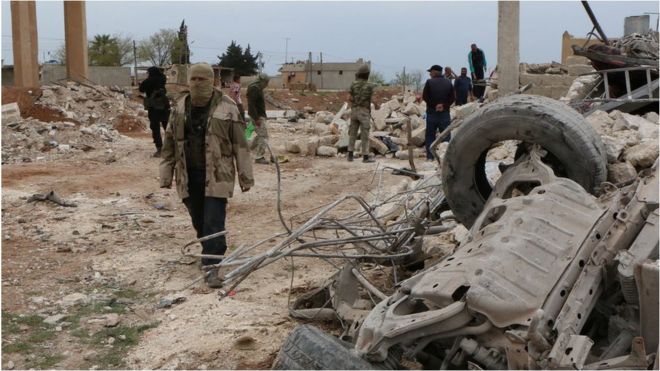

Divisions among world leaders on resolving the war in Syria have been laid bare in speeches at the UN General Assembly (UNGA).
The US and France insisted Syria’s President Bashar al-Assad must go, but Russia said it would be an “enormous mistake” not to work with him to tackle Islamic State (IS) militants.
The US and Russia hinted at compromise.
Barack Obama said he would work with any nation, and Vladimir Putin called for a “broad coalition”.
The pair will meet in New York later.
In his speech, Mr Obama said compromise among powers would be essential to ending the Syrian conflict, which has claimed more than 200,000 lives and forced four million to flee abroad.
“Lasting stability can only take hold when the people of Syria forge an agreement to live together peacefully,” he said.
“The US is prepared to work with any nation, including Russia and Iran, to resolve the conflict. But we must recognise that there cannot be, after so much bloodshed, so much carnage, a return to the pre-war status quo.”
Speaking soon after, Mr Putin said it was an “enormous mistake to refuse to cooperate with the Syrian government and its armed forces who are valiantly fighting terrorism face-to-face”.
He also called for the creation of a “broad anti-terror coalition” to fight IS, comparing it to the international forces that fought against Nazi Germany in World War Two.
The US and Russian leaders have long differed on Syria: the US opposes President Bashar al-Assad remaining in power, while Russia has been a staunch ally, and has recently stepped up military support.
Some Western leaders have recently softened their stance towards the Syrian president, conceding that he might be able to stay on during a political transition.
UK Prime Minister David Cameron is expected to reflect that in talks this week.
Iran’s President Hassan Rouhani, a key Syrian ally, said his country was prepared to help in “paving the way for democracy” in Syria.
But French President Francois Hollande said that, while he was prepared to work with Iran and Russia, he would explain to them that “the route to a solution does not go through Bashar al-Assad”.
Syria’s civil war
What’s the human cost?
More than 250,000 Syrians have been killed and one million injured in four and a half years of armed conflict, which began with anti-government protests before escalating into a full-scale civil war.
And the survivors?
More than 11 million others have been forced from their homes, four million of them abroad, as forces loyal to President Assad and those opposed to his rule battle each other – as well as jihadist militants from IS. Growing numbers of refugees are going to Europe.
How has the world reacted?
Regional and world powers have also been drawn into the conflict. Iran and Russia, along with Lebanon’s Hezbollah movement, are propping up the Alawite-led government. Turkey, Saudi Arabia and Qatar are backing the Sunni-dominated opposition, along with the US, UK and France.
UN Secretary General Ban Ki-moon said five countries – Russia, the US, Saudi Arabia, Turkey and Iran – were key to finding a political solution in Syria, but unless they could compromise, it would be “futile” to expect change on the ground.
Moscow has suggested there are plans to form an international contact group involving all the countries Mr Ban mentioned plus Egypt.
The threat of IS extremists and the flow of Syrian refugees to Europe has added urgency to the search for a deal to end the civil war.
A US-led coalition has been carrying out air strikes against IS in Syria and Iraq for more than a year.
The UK announced this month it had carried out a drone strike against two British citizens in Syria, but has yet to fly manned operations in Syrian airspace.
–
By: BBC