

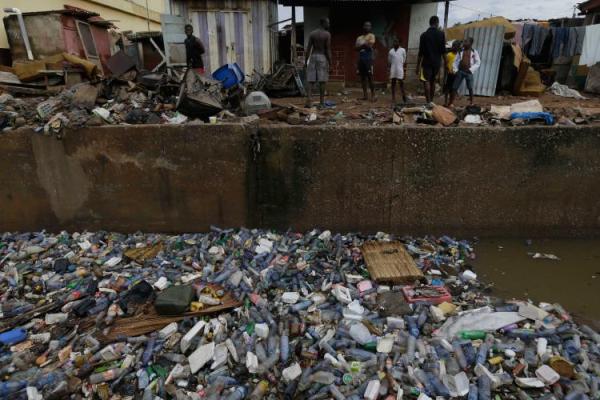

Ghana has slipped further on its sanitation performance globally to become the World’s 7th worst performing country, according to a new report released on Tuesday.
The Joint Monitoring Programme report, “Progress on Sanitation and Drinking Water: 2015 Update and MDG Assessment,” a collaborative effort between the World Health Organisation (WHO) and the United Nations Children’s Fund, says that the challenge to access improved sanitation is starker in Ghana, “which has slipped even further amongst the worst performing countries, now ranked 7th worst globally.”
Ghana was ranked the 10th worst country in last year’s report, which indicates that its performance on sanitation coverage has worsened in the past year, Mr David Duncan, the Chief of WASH (water, sanitation and hygiene) at the UNICEF office in Ghana, told the Daily Graphic.
Ghana, which currently has a sanitation coverage of 15 per cent, is ranked after South Sudan which has a seven per cent coverage, Niger, 11 per cent; Chad, Madagascar and Togo, 12 per cent each and Sierra Leone which has a 13 per cent access to household toilets, the measurement used for the ranking.
Mr Duncan said that although in 1990 when Ghana had seven per cent coverage Ethiopia only had three per cent coverage; the country had been bypassed by Ethiopia, which now has 28 per cent coverage, while Guinea has also progressed from eight to 20 per cent.
He was also full of commendation for countries like Syria and Afghanistan which currently have coverages of 96 per cent and 32 per cent respectively despite being in wars.
Changing a status quo
To change Ghana’s current status as one of the world’s worst performing countries in sanitation coverage, Mr Duncan said there was the need for more investment in the sector. “At the moment there is a broad sanitation model and strategy, which definitely is rolling out and that will help dramatically but we need more investment in sanitation and the challenge is that we really need that commitment,” he said.
According to a statement announcing the findings of the report, “in Ghana, the goal to meet the Millennium Development Goal (MDG) on access to water was quickly met ahead of time. However, the indicators for sanitation targets closely mimic that of the global numbers – every fifth Ghanaian, or 5 million people defaecate in the open.”
It also said that while in Ghana about 7,500 children die annually from diarrhoea, which is linked to unsafe drinking water, poor sanitation, or poor hygiene, studies also show that only one in eight Ghanaians regularly wash their hands, a situation which aggravates outbreaks such as cholera.
The report suggests that children especially are disproportionally affected and that globally, disparities account for the inability to achieve universal access to water and sanitation, adding that there is still a lot to do, as a lack of water and sanitation and hygiene lead to a large burden of disease which is completely preventable.
Quoting the report, the statement said that worldwide, one in three people, or 2.4 billion, are still without sanitation facilities – including 946 million people who defaecate in the open.
Impact of lack of sanitation access
Meanwhile, WHO and UNICEF have cautioned that the lack of progress on sanitation threatens to undermine the child survival and health benefits from gains in access to safe drinking water.
Commenting on the latest report, Madam Rushnan Murtaza, the UNICEF Ghana representative, said “Sanitation is important to maternal, newborn child health and child nutrition, unfortunately, the results of poor sanitation claims the lives of too many children.”
The report also says that it is critical to learn from the uneven progress of the 1990-2015 period, to ensure that the Sustainable Development Goals (SDGs), close the inequality gaps and achieve universal access to water and sanitation.
–
Source: Graphic Online