
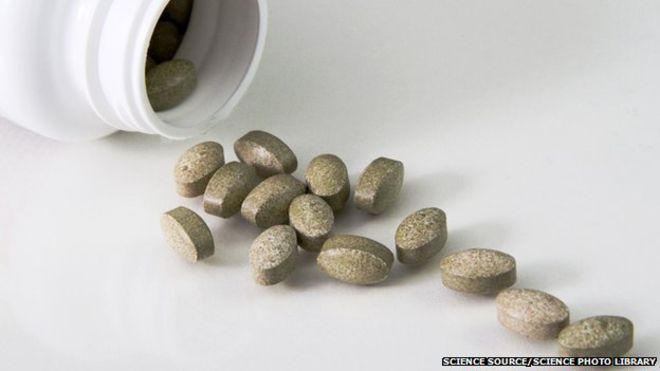

Some herbal food supplements do not contain what they claim on the label, a study has found.
The BBC health series ‘Trust Me, I’m a Doctor’ teamed up with experts from University College London to test a selection of products bought from high street shops or online retailers.
Of 30 ginkgo products tested, eight contained little or no ginkgo extract.
In one case of milk thistle, unidentified substances were present in place of milk thistle.
All the evening primrose products performed well.
The UCL team tested around 70 products overall, using two methods – nuclear magnetic resonance spectroscopy and high performance thin layer chromatography – to study their composition.
Regulation
Herbal products can be sold either as food supplements, or as Traditional Herbal Registration (THR) remedies.
In every THR tested, the product contained what was claimed on the label.
However, the food supplements showed a wide range of quality. Whilst many contained high amounts of the herbal ingredient as claimed, several had none at all.
The manufacture of THRs falls under regulation by the Medicines and Healthcare Products Regulatory Authority (MHRA), but herbal food supplements come under the remit of the Food Standards Agency (FSA) and Trading Standards at local authority level. Their manufacture is not regulated.
Head of the UCL research team Professor Michael Heinrich said: “I think some of the suppliers of food supplements are lying. In other cases I think they don’t know what they’re doing. Many of the botanical drugs come from rare or increasingly rare species, so it makes perfect sense to get something cheaper…which helps to you get a better price at a lower cost.”
He warned consumers that a high price tag was no guarantee of quality.
A spokesman for the Food standards Agency said: “The FSA champions the rights of consumers and misleading them in this way is unacceptable.”
He said a herbal food supplement would be investigated if a complaint was made about a specific product, if members of the public were to fall ill as a result of taking these products, or if evidence of mislabelling were provided.
The results of the BBC/UCL tests have been passed on to the FSA’s Food Crimes Unit.
Source: BBC