

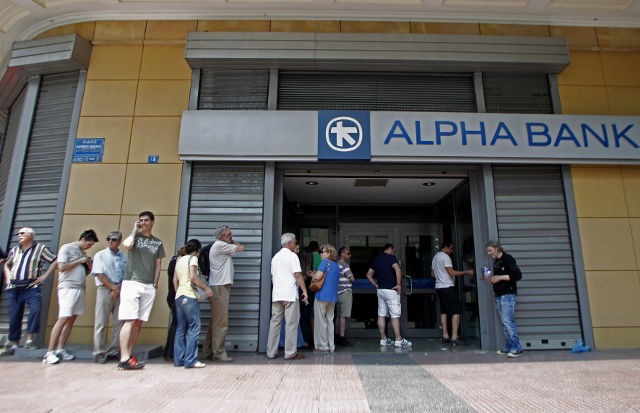

Greece has closed its banks and imposed capital controls to prevent financial chaos after the breakdown of bailout talks with its international creditors.
The move came at the end of a weekend which saw Greece lurch closer to a potential exit from the European single currency, confronting the eurozone with a rupture unprecedented since its launch in 1999.
Greece’s financial stability council, grouping the banks, regulators and government, decided to impose the controls on Sunday night after the European Central Bank said it would freeze the amount of emergency loans it supplied to keep the Greek banking system afloat.
Announcing the capital controls on television, Alexis Tsipras, Greece’s prime minister, assured Greeks that their bank deposits were safe.
He blamed the European authorities for the move, saying they were meant “to stifle the will of the Greek people. They will not succeed.”
The shutdown of the banks would last until at least July 6 and cash withdrawals will be limited to €60 a day according to Bloomberg, citing a statement by the Greek government.
The cashing of cheques would be halted and fixed term deposits would be locked down. The Athens stock exchange will also be closed.
The day’s events followed a move by the Greek government late on Friday night to call a referendum on new bailout terms offered by the country’s international creditors, triggering a showdown with Greece’ eurozone partners and pushing the country closer to “Grexit” — Greek exit from the eurozone.
Eurozone finance ministers on Saturday refused a Greek request to extend the bailout programme which is scheduled to end on Tuesday, leaving the fragile Greek financial system exposed.
The two sides were deadlocked over plans to give Greece €15.3bn in urgently needed loans in exchange for austerity measures and structural reforms.
The US stepped up its intervention in the crisis, with President Barack Obama calling Angela Merkel, the German chancellor, to urge moves to ensure that Greece remained in the eurozone.
Jack Lew, US Treasury secretary, issued a statement after talks with his German and French counterparts urging creditors to consider debt relief for Greece, a position resisted strongly by Germany and other euro members.
Pierre Moscovici, EU economy commissioner, tweeted that the door was still open for talks to keep Greece in the eurozone.
The ECB’s policy making governing council said on Sunday it could no longer provide extra funding for Greece’s lenders. It pledged to work with Greece’s central bank to “maintain financial stability”.
“Following the decision by the Greek authorities to hold a referendum and the non-prolongation of the EU adjustment programme for Greece, the governing council declared it will work closely with the Bank of Greece to maintain financial stability,” the ECB said.
It added that the ECB “stands ready to reconsider its decision” — leaving the door open to emergency intervention.
Escalation in the Greek debt crisis is widely expected to trigger a sharp reaction on financial markets on Monday.
A key focus will be on eurozone sovereign bond markets for any sign of contagion hitting “periphery” countries, including Spain, Italy and Portugal.
William Dudley, the president of the Reserve Bank of New York, said Greek risk was a “huge wild card”.
He warned in an interview with the Financial Times that the financial market implications of a Greek exit from the euro could be graver than many investors seemed to believe, because it would set a “huge precedent” indicating that euro membership was reversible.
“My personal view is if this goes badly the market reaction may be bigger than what we realise,” he said.
Without any new funds from the ECB, Greek banks are likely to struggle to honour the deposit withdrawals that are expected in the run-up to the July 5 referendum.
Greek banks have relied on the emergency funding since February, when the eurozone’s central bankers cut off access to their regular loans.
Up to €89bn in emergency loans, dubbed Emergency Liquidity Assistance, had been approved by the council, made up of the heads of the national central banks and the ECB’s six senior officials — led by president Mario Draghi.
Billions of euros have left the Greek banking system as the relationship between Athens and its international creditors has deteriorated.
Mr Draghi said: “We continue to work closely with the Bank of Greece and we strongly endorse the commitment of member states in pledging to take action to address the fragilities of euro area economies.”
Yannis Stournaras, the Greek central bank governor, said: “The Bank of Greece, as a member of the eurosystem, will take all measures necessary to ensure financial stability for Greek citizens.”
In a sign that Greece’s creditors will continue to apply pressure to Mr Tsipras during the referendum campaign, the European Commission late on Sunday published a 10-page revised bailout offer that it said it was prepared to offer Athens before Mr Tsipras unexpectedly cut off talks on Friday night.
The revised offer contains few additional concessions: the most significant was agreeing to Greek demands that hotels be included in a 13 per cent value added tax bracket to protect its tourism industry rather than the 23 per cent standard rate. But the move illustrated how deeply Mr Tsipras’ decision to hold a referendum has damaged the eurozone’s trust in his government, calling into question whether any agreement to avoid Grexit can be reached.
“This is the offer that could have been but wasn’t,” said one EU diplomat.
“People should know what should have been.”
–
Source: Financial Times