

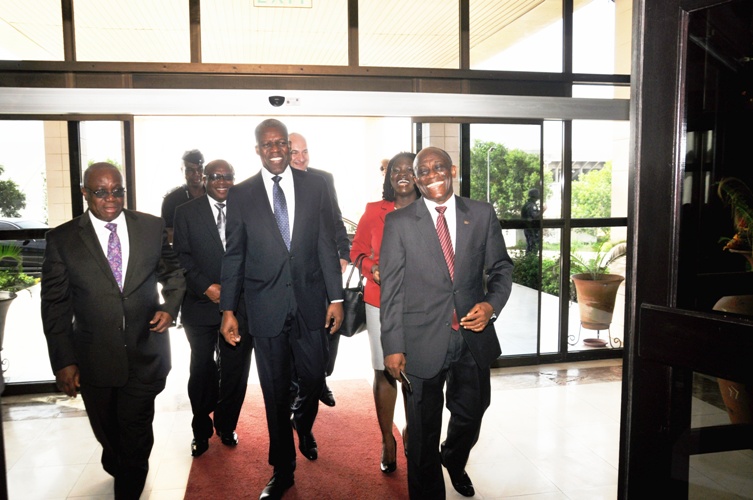

Vice President Kwesi Amissah-Arthur has stated that the government is taking the right measures to ensure the country moves into the future with confidence.
He said despite disastrous policy choices that the country made in the past, Ghana emerged successfully from its economic recovery programme.
Vice President Amissah-Arthur was speaking at the launch of the International Monetary Fund (IMF) Africa Regional Economic Outlook in Accra.

The 110-page economic survey titled: “Regional Economic Outlook– Sub-Saharan Africa, Navigating the headwinds,” provides the academic latest data, reveals economic trends in the region, and shows analysis and economic policy choices and the implication of these policy choices on Sub-Saharan African countries.
The launch was also attended by economic experts across Africa, the Ministers of State, Governor of the Bank of Ghana, Economic Think-Tanks and Civil Society Groups.
Vice President Amissah-Arthur stated that despite the challenges facing many Sub-Saharan African countries, their economic prospects for the year were bright.
He said Ghana over the years has represented Africa’s economic contradictions, its failures and success with few of the countries replicating these choices.
According to him, the Regional Economic Outlook shows Africa as a region of contrast, growth expanding at a favourable rate even as global financial conditions impacts negatively on them.
Vice President Amissah-Arthur further stated that many of the countries in the region have had to confront security and health related risk despite improvement political stability in those nations.
He said though the Arab Spring started in North Africa its impact was felt mostly in Sub-Saharan Africa and therefore provided some observers the curiosity about how the Africa department of the IMF views the region.
“We believe the IMF understand our story, our history and appreciate the choices that Africa must make so that we can achieve our long term goals,” he added.

Antoinette Sayeh, the Director of the IMF’s African Department, speaking at the launch, projected that Sub-Saharan Africa’s economy is set to register another year of solid economic performance with growth expected to expand by 4.5 per cent in 2015.
She said the region would continue to be one of the fastest growing in the world, second only to emerging and developing countries of Asia.
She said the economic expansion would be at the lower end of the range experienced in recent years, mainly reflecting the impact of the sharp decline of oil and commodity prices over the last six months, adding that, the impact of this shock will be highly differentiated across the region.
Ms Sayeh also noted that Sub-Saharan Africa’s eight oil exporters have been hard hit by the price decline, and their average growth in 2015 is expected to be about 1.25 percentage points lower than in 2014 in response to this shock.
She however mentioned that the growth prospects for most of the rest of the region would remain favorable.
According to her, even though the Ebola outbreak in Guinea, Liberia and Sierra Leone is under control with a sharp decline in the incidence of new infections, however, 2015 would be another difficult year for the Ebola affected countries with economic activity expected to be significantly depressed.
Ms Sayeh further stated that whilst the baseline scenario projects a solid growth for Sub-Saharan African countries, policy makers need to remain mindful of risks that could still cloud the outlook.
She noted in particular that, the global financial conditions are tightening just as the region’s frontier markets are increasingly relying on Eurobonds to finance their large investment needs.
She said the deteriorating security situation in some areas could also strain budgets and have an adverse impact on the near-term growth outlook, especially in the agricultural sector, while weakening prospects for foreign direct investment.
Source: GNA