

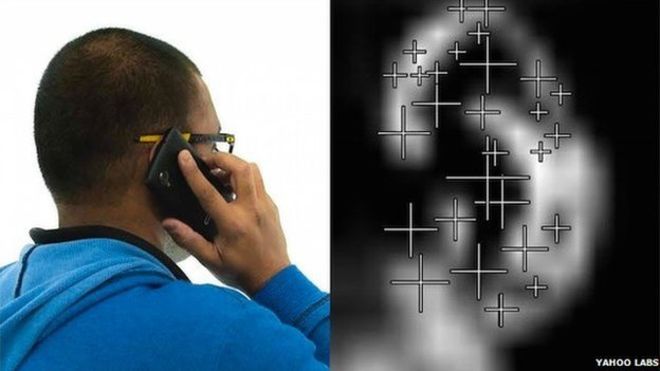

Yahoo is working on a way of unlocking a mobile phone using the owner’s ear rather than a password or fingerprint.
It is also looking to use fists or even the way people grip their smartphone as alternative forms of biometric authentication.
Fingerprint scanners on mobile phones are increasingly popular, but expensive.
Yahoo is looking to use the phone’s touchscreen as the image sensor, which would be far cheaper.
The system, developed at Yahoo Labs, is dubbed Bodyprint and has had initial trials with 12 participants.
“Due to their cost, capacitive fingerprint scanners have been limited to top-of-the-line phones, a result of the required resolution and quality of the sensor,” the team said on its website.
While the input resolution of a touchscreen is relatively low, “the surface area is large, allowing the touch sensor to scan users’ body parts, such as ears, fingers, fists and palms by pressing them against the display”, the team said.
It identified body parts with 99.98% accuracy and users with 99.5% accuracy. Scanning ears achieved a 99.8% accuracy rate, according to the team.
Swiss robbers
Biometrics expert Prof Angela Sasse, from University College London’s department of computer science, thinks that such a system could have a future as a way of opening mobile phones securely.
“Research into this has been going on for a few years, but it is new in terms of deployment,” she said.
It was not the first time ears had been used as a method of identification, she said.
In Switzerland such methods are used at the scene of a robbery, to help identify the offender.
“Burglars tend to listen on the windowpane to see if anyone is home,” said Prof Sasse.
Police then take a print of the ear, rather like a fingerprint.
One benefit of an ear-based identification system was that it offered greater privacy than facial recognition, she told the BBC.
Fingerprint scanners, popular on latest iPhone models and on some Android handsets, have proved to be vulnerable to hackers.
In April, security firm FireEye reported how hackers could take copies of fingerprints used to unlock the Samsung Galaxy S5 phone.
The latest research into biometrics is focused on behavioural biometrics, for example how you type a word, which can be extremely accurate, according to Prof Sasse.
–
Source: BBC